File Information
287.85 KB • APPLICATION/PDF
Description
What is included in this PDF:
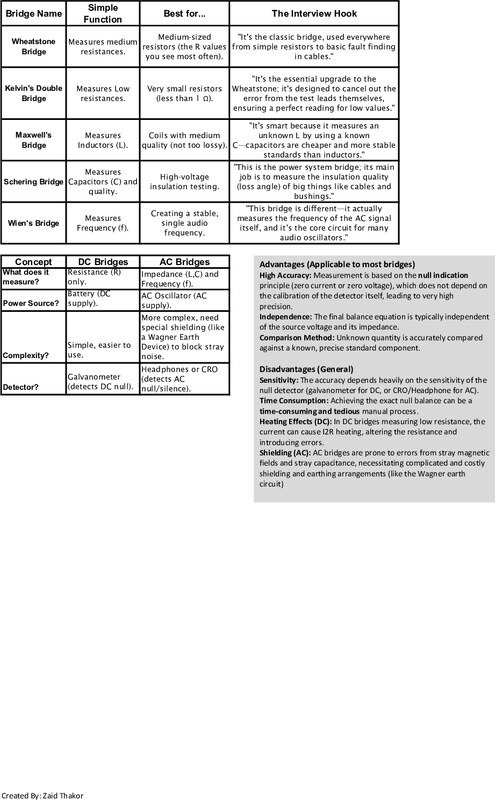
1. Core Bridge Breakdown: Simple functions and best use cases for Wheatstone, Kelvin's Double (for low resistance $< 1 \Omega$), Maxwell's, Schering, and Wien's Bridges.
2. The "Interview Hook": Standout, professional explanations for each bridge designed specifically to impress interviewers.
3. AC vs. DC Bridges: A clear conceptual comparison covering what they measure, power sources, complexity, and detector types (Galvanometer vs. CRO/Headphones).
4. Pros & Cons: A summary of general advantages (like high accuracy via the null indication principle) and disadvantages (like $I^2R$ heating effects and stray magnetic field errors requiring a Wagner earth circuit).
Ideal for B.E. students studying Basic Electrical Measurement and professionals preparing for technical PSU interviews.
Content Notice
All study notes available on ShareMyNotes are uploaded by members of the community for educational and reference purposes only. Browse our complete collection of study materials. ShareMyNotes does not claim ownership of any third-party content and does not host or promote copyrighted books or official publications.
We conduct manual inspections and periodic reviews of uploaded content. Users can report or flag any note they believe violates copyright or platform policies using the flag option available in the actions section of each note. Reported content may be removed at any time upon review. Learn more about our content policies.
If you are the rightful copyright owner or an authorized representative and believe that any content on this page infringes your copyright, please contact us for prompt removal. Check our Terms of Service for detailed policies.
Actions
This content is community-uploaded for educational use. Use the flag option to report copyright concerns. Learn about our uploading guidelines.
Preview Download Login to Like💚 Support ShareMyNotes ☕
ShareMyNotes is built with one goal — to help students access quality notes and study material for free, without barriers.
Creating, reviewing, hosting, and maintaining these resources takes time, effort, and real costs. If this note helped you even a little, your support can make a big difference.
Even ₹10–₹50 helps us keep ShareMyNotes running, improving content quality, and supporting thousands of students like you ❤️
☕ Buy Me a Coffee100% of donations are used to maintain and improve ShareMyNotes and to keep this platform free and accessible for students.
No pressure — your support simply helps us continue this mission.
Flag and Report
Notice an issue with this note? You can report it using the option below.
More Books You May Like
Hand-picked resources to boost your learning


About the Author

Zaid Thakor
A B.E. Electrical Engineer specializes in creating high-quality, practical study materials, PPTs, and visual guides. My notes bridge the gap between academic theory and real-world application, covering core engineering concepts, semester notes, and industrial safety protocols to help students master their coursework and prepare for technical PSU recruitment exams
View Profile View All NotesFeatured Blogs

ShareMyNotes.in: Revolutionize Your Learning with the Ultima ...
Nov 08, 2025
Best Biology Handwritten Notes for NEET Toppers
Nov 25, 2025
Top Education Discussion Forums You Should Join
Nov 26, 2025
Where to Find CBSE Class 10 & 12 Previous Year Question Pape ...
Dec 02, 2025
Free IIT JEE Notes PDF | Physics, Chemistry & Maths
Dec 26, 2025Discussion Forum
Join the community discussion forum
Comments 1
Very good explanation and all in one sheet, that's too useful for interviews as well as for exams