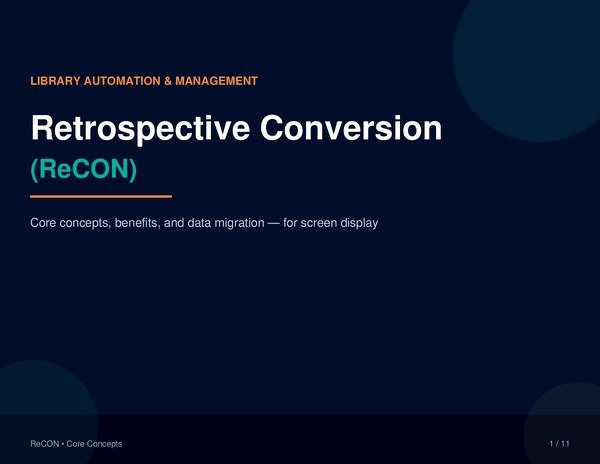
File Information
22.19 KB • APPLICATION/PDF
Tags
ReCONDescription
Purpose:
To migrate historical or non-digital records into a searchable, accessible, and interoperable digital database.
To improve discovery, preservation, and management of library resources.
Scope:
Applies to bibliographic records (e.g., books, journals, manuscripts) and authority records (e.g., authors, subjects).
May include item-level data (e.g., barcodes, call numbers, circulation history).
Methods:
Manual Entry: Data is manually typed into the system, often used for small collections or highly specialized materials.
OCR (Optical Character Recognition): Scanned images of catalog cards or printed catalogs are converted to text using OCR software.
Outsourcing: Libraries may contract third-party vendors specializing in retrospective conversion services.
Batch Loading: Pre-existing digital records (e.g., from spreadsheets or older ILS exports) are imported in bulk using MARC (Machine-Readable Cataloging) standards or other formats like CSV, XML, or JSON.
Standards:
Records are typically converted to MARC 21, UNIMARC, or Dublin Core formats for compatibility with modern library systems.
Authority control (e.g., LC Subject Headings, Dewey Decimal Classification) is applied to ensure consistency.
Challenges:
Data Cleanup: Legacy records may contain inconsistencies, missing fields, or outdated terminology requiring normalization.
Cost and Time: Large-scale conversion can be resource-intensive.
Quality Assurance: Validation is critical to ensure accuracy, completeness, and adherence to cataloging standards.
Benefits:
Enhances accessibility for patrons and staff.
Facilitates interlibrary loan (ILL) and resource-sharing initiatives.
Supports preservation by reducing reliance on physical or obsolete formats.
Enables advanced search and analytics (e.g., faceted search, usage statistics).
Tools and Protocols:
MARC Edit Software (e.g., MarcEdit, MARC Report).
Library Services Platforms (e.g., Koha, Alma, Sierra).
Data Transformation Tools (e.g., OpenRefine, XSLT scripts).
Protocols: Z39.50, SRU, or OAI-PMH may be used for data exchange during conversion.
Example Workflow:
Inventory: Audit existing records to determine scope.
Digitization: Scan or export legacy records.
Conversion: Apply OCR or manual entry to create digital records.
Standardization: Map fields to MARC or another target schema.
Validation: Review for errors, duplicates, or missing data.
Loading: Import into the ILMS or catalog.
Testing: Verify searchability and integration with other systems.
Content Notice
All study notes available on ShareMyNotes are uploaded by members of the community for educational and reference purposes only. Browse our complete collection of study materials. ShareMyNotes does not claim ownership of any third-party content and does not host or promote copyrighted books or official publications.
We conduct manual inspections and periodic reviews of uploaded content. Users can report or flag any note they believe violates copyright or platform policies using the flag option available in the actions section of each note. Reported content may be removed at any time upon review. Learn more about our content policies.
If you are the rightful copyright owner or an authorized representative and believe that any content on this page infringes your copyright, please contact us for prompt removal. Check our Terms of Service for detailed policies.
Actions
This content is community-uploaded for educational use. Use the flag option to report copyright concerns. Learn about our uploading guidelines.
Preview Download Login to Like💚 Support ShareMyNotes ☕
ShareMyNotes is built with one goal — to help students access quality notes and study material for free, without barriers.
Creating, reviewing, hosting, and maintaining these resources takes time, effort, and real costs. If this note helped you even a little, your support can make a big difference.
Even ₹10–₹50 helps us keep ShareMyNotes running, improving content quality, and supporting thousands of students like you ❤️
☕ Buy Me a Coffee100% of donations are used to maintain and improve ShareMyNotes and to keep this platform free and accessible for students.
No pressure — your support simply helps us continue this mission.
Flag and Report
Notice an issue with this note? You can report it using the option below.
More Books You May Like
Hand-picked resources to boost your learning


About the Author
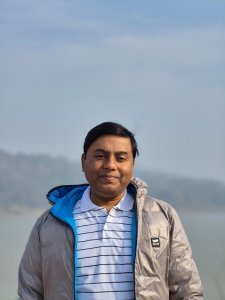
Prof. Rupak Chakravarty
Professor Rupak Chakravarty is a accomplished academic with about 25 years of professional experience, including over 19 years in teaching. He has successfully guided 11 Ph.D. scholars to completion and currently supervises eight more. Aprolific contributor to capacity building, he has served as a resource personfor over250 skilling programmes and authored around 150 research papers. His primaryinterests are the ethical use of AI in research, open access, academic integrity, andemerging library technologies. Prof. Rupak has held editorial responsibilities, including three consecutive years as Associate Editor for the DOAJ (Directoryof Open Access Journals), and he reviews for Scopus-indexed journals andservesinjournal editor roles. He has undertaken numerous significant academic assignmentsand committee memberships. These include roles in the Doctoral ResearchCommittee (DRC), Board of Control, Research Degree Committee, Board of Studies, Departmental Academic and Administrative Committees, Research AdvisoryCommittees (RAC), Academic Council, thesis and dissertation evaluations, university administrative committees, Internal Quality Assurance Cell (IQAC), placement cell, alumni association, and screening and selection committees. He is also involved in departmental consultancy services and the mentor–mentee programAdditionally, he has been associated with University Grants Commission(UGC), Public Service Commissions, and State Governments. He contributed educational modules and video lectures to ePG-PathshalaandVidyaMitra under the National Mission on Education through ICT (NMeICT). Since March 2024 he has been Research Fellow at INTI International University, Malaysia. Prof. Rupak Chakravarty Department of Library & Information Science Panjab University, Chandigarh 160014.
View Profile View All NotesFeatured Blogs

ShareMyNotes.in: Revolutionize Your Learning with the Ultima ...
Nov 08, 2025
Best Biology Handwritten Notes for NEET Toppers
Nov 25, 2025
Top Education Discussion Forums You Should Join
Nov 26, 2025
Where to Find CBSE Class 10 & 12 Previous Year Question Pape ...
Dec 02, 2025
Free IIT JEE Notes PDF | Physics, Chemistry & Maths
Dec 26, 2025Discussion Forum
Join the community discussion forum
Comments 0
No comments yet. Be the first to share your thoughts!