File Information
3.32 MB • APPLICATION/PDF
Description
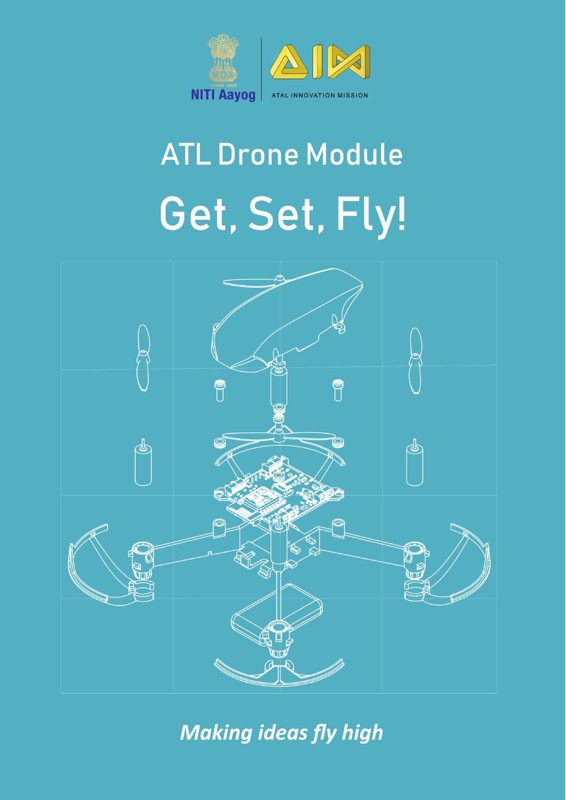
Drones also known as UAV is an abbreviation of Unmanned Aerial Vehicle, meaning
aerial vehicles which operate without a human pilot on board. UAVs are commonly used in
both the military and police forces in situations where the risk of sending a human piloted
aircraft is unacceptable, or the situation makes using a manned aircraft impractical. In modern
times drones are gaining popularity in day to day applications, you can see examples of them
in the later part of the module
2.2 History of drones
Wars have generally wreaked havoc on countries that have been a part of it. As
societies and civilisations evolved, the number of wars waged in different parts of the world
went down and we are probably living in one of the most peaceful times ever on the planet.
There is however one (and probably the only one) advantage of wars - technology innovations
that come out into the world. Many innovations - the GPS, nuclear energy, IC Engine, Satellites
and a bunch of others - came from defence necessities. Drones had a similar beginning.
The first drone was built for a war. In the year 1849, Austrians were attacking Venice.
They had already besieged the city to try and starve it off food. They launched large pilotless
balloon with the explosives attached to it to fly into the city. However, the winds started
blowing in opposite direction and exploded right above the Austrians.
Since then, there were incremental innovations that were happening over the period
of a century and a half. Drones came in form of large pilotless planes and weapon-delivery
systems. In the late 1990s, drones started becoming smaller in size. In With the advent of the
BLDC motors and high energy density lithium polymer batteries, the efficiencies improved and
the costs came down. That is the time the drone revolution started taking birth on this planet.
Even then, the applications of drones were very focused on the military. The drones
slowly started bringing cameras with better cameras and image stabilisation technologies.
That is when drones started being used for their first non-military application - aerial
photography and cinematography. And as software for image processing and data gathering
improved, drones started being used for newer applications. These included precision
agricultures, land surveying, mapping and a bunch of other such ideas. In the next phase, as
the battery technology improves further (think of fuel cells), we will see more usages in form
of payload deliveries and very high endurance.
2.3 India and drones
The Unmanned Aircraft System ("UAS") market in India is projected to touch US$ 886
million by 2021, while the global market is likely touch US$ 21.47 billion. With such a growing
economy, it becomes important for India as country to foster drone innovations.
Countries across the world realise the potential of drones and are investing in the
growth of drone innovations. But they also understand the risks posed by unfettered usage of
drones and have laid down rules for drone usage. The first body to bring this out was the FAA
of the USA. Soon, other countries followed suit. India’s DGCA has also brought out its own set
of rules to govern the Indian skies via RPAS regulations.
2.4 Tinkering and drones
The human race strives because they are curious. The ability to ask questions is one of
the most fundamental reasons of human evolution. And this can be seen throughout the
history of human evolution. Explorers first conquered the land till they reached a shore. To
cross the blue oceans, they created the ‘Ship’ and conquered the planet. Then the explorers
looked up and saw the blue sky, eventually creating ‘space-ship’.
During one’s lifetime, a human being is the most curious at childhood. And as natural
explorers, we tend to like the idea of flying, solely because it gives us an opportunity to expand
our horizons and see the unknown. Tinkering, is an output to the curious mind and flying
objects foster the idea of exploration. Thus, a need was felt to create a module to connect
Tinkering and drones.
The drone technology has proven to be one of the most promising technologies of the
4th industrial revolution. And it is imperative that a platform is created to enable students to
explore this technology early in their life and in a collaborative environment, like an ATL
environment in schools. In school, students learn various concepts of physics and mathematics
during their daily curriculum-based classes, and further get an opportunity to work them out
in real life with the help of the ATL and this module. This authentic hands-on experience will
result in students creating their own innovations at a grassroot level.
Throughout this experience, students will be empowered to understand various
concepts, for e.g Mathematics - algebra and calculus; physics - Laws of Motion, Force,
Mechanics and Electronics; geometry - 3D geometry and spatial problem-solving skills.
2.5 Do’s and Don’ts
It is important to use technology holistically and responsibly. Readers are requested to take
note of the regulations issued by the Government of India, in public interest.
Following is a list of Do’s and Don’ts for flying drones2
:
2.5.1 Do’s:
• Ensure your drone (except Nano in uncontrolled airspace upto 50 feet) is Digital Sky
“No Permission- No Take off” (NPNT) compliant.
• Obtain Unique Identification Number (UIN) from DGCA for operating in controlled
airspace (where the ATC services are active) and affix it on your drone.
• Obtain Unmanned Aircraft Operator Permit (UAOP), if applicable from DGCA for
commercial operations and keep it handy.
• Obtain permission before each flight through Digital Sky Platform which are available
on DGCA website from December 1, 2018.
• Keep an eye on interference which can be from mobile devices or blockage of signals.
• Fly only during daylight (after sunrise to before sunset).
• Fly in good weather: Good weather lets you not only fly your drone better but also
keep track of it in the air.
• Fly in visual line of sight (VLOS): Always be within visual range of your drone.
• Be aware of airspace restrictions/ no drone zones and respect privacy of people.
• Keep local police informed about your drone flying activity. If you are ever approached
by police provide all requisite information.
• Do log your flights and intimate concerned authorities (like DGCA, local police etc.) of
any incidents/ accidents.
Content Notice
All study notes available on ShareMyNotes are uploaded by members of the community for educational and reference purposes only. Browse our complete collection of study materials. ShareMyNotes does not claim ownership of any third-party content and does not host or promote copyrighted books or official publications.
We conduct manual inspections and periodic reviews of uploaded content. Users can report or flag any note they believe violates copyright or platform policies using the flag option available in the actions section of each note. Reported content may be removed at any time upon review. Learn more about our content policies.
If you are the rightful copyright owner or an authorized representative and believe that any content on this page infringes your copyright, please contact us for prompt removal. Check our Terms of Service for detailed policies.
Actions
This content is community-uploaded for educational use. Use the flag option to report copyright concerns. Learn about our uploading guidelines.
Preview Download Login to Like💚 Support ShareMyNotes ☕
ShareMyNotes is built with one goal — to help students access quality notes and study material for free, without barriers.
Creating, reviewing, hosting, and maintaining these resources takes time, effort, and real costs. If this note helped you even a little, your support can make a big difference.
Even ₹10–₹50 helps us keep ShareMyNotes running, improving content quality, and supporting thousands of students like you ❤️
☕ Buy Me a Coffee100% of donations are used to maintain and improve ShareMyNotes and to keep this platform free and accessible for students.
No pressure — your support simply helps us continue this mission.
Flag and Report
Notice an issue with this note? You can report it using the option below.
More Books You May Like
Hand-picked resources to boost your learning


About the Author
Ajay kumar lodhi
Ajay Kumar Lodhi is an educator and technologist with an M.Tech in Robotics, a B.Tech in Mechanical Engineering, and an M.A. in History. He is the founder of ShareMyNotes and Aakar Lab, where he focuses on making quality education, engineering, and technology learning accessible through practical, student-friendly, and exam-oriented resources.
View Profile View All NotesFeatured Blogs

ShareMyNotes.in: Revolutionize Your Learning with the Ultima ...
Nov 08, 2025
Best Biology Handwritten Notes for NEET Toppers
Nov 25, 2025
Top Education Discussion Forums You Should Join
Nov 26, 2025
Where to Find CBSE Class 10 & 12 Previous Year Question Pape ...
Dec 02, 2025
Free IIT JEE Notes PDF | Physics, Chemistry & Maths
Dec 26, 2025Discussion Forum
Join the community discussion forum
Comments 0
No comments yet. Be the first to share your thoughts!